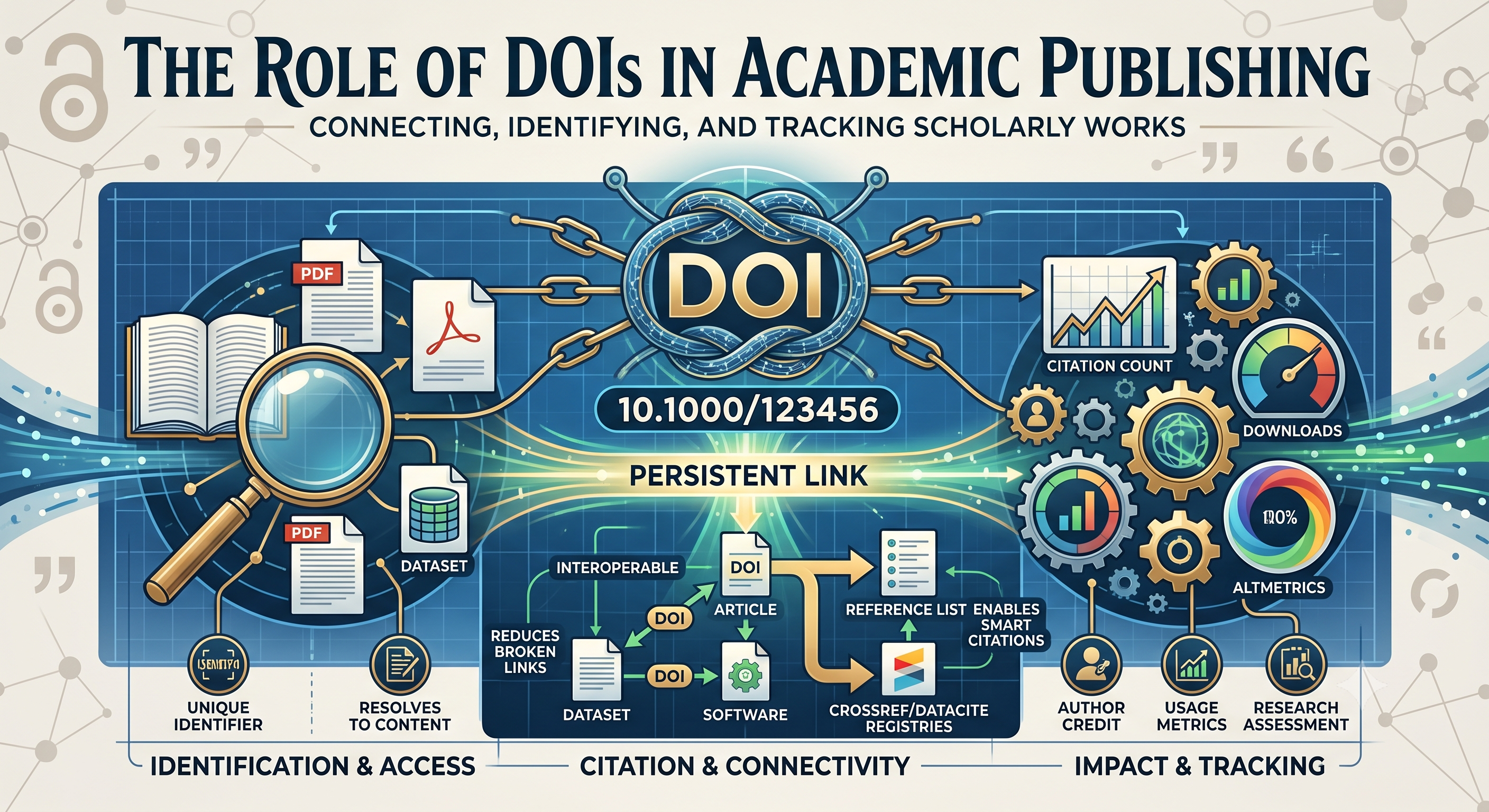
The Role of DOIs in Academic Publishing
Introduction
In the digital era, academic publishing has evolved beyond printed journals and physical libraries. Today, millions of scholarly articles, books, conference papers, datasets, and research reports are accessed online every day. As the volume of digital content continues to grow, ensuring that research remains discoverable, accessible, and permanently identifiable has become increasingly important. This is where the Digital Object Identifier (DOI) plays a crucial role.
A DOI is a unique and persistent identifier assigned to digital scholarly content. Unlike ordinary web links that may become inactive over time, a DOI provides a permanent pathway to a publication, ensuring that researchers can reliably locate and cite academic work. DOIs have become an essential component of modern scholarly communication, improving citation accuracy, research visibility, and the long-term accessibility of scientific knowledge.
What Is a DOI?
A Digital Object Identifier (DOI) is a unique alphanumeric string assigned to a digital research object, such as:
- Journal articles
- Books and book chapters
- Conference proceedings
- Research datasets
- Technical reports
- Theses and dissertations
- Supplementary research materials
Each DOI is permanently associated with a specific publication and remains unchanged even if the publication moves to a different website or publisher.
For example:
10.1234/abcd.2026.001
This identifier acts as a permanent digital fingerprint that distinguishes one scholarly work from every other publication.
Why Are DOIs Important?
Academic research depends on accurate referencing and reliable access to scholarly literature. Traditional web addresses (URLs) may change because of website redesigns, publisher migrations, or server updates. When this happens, links can become broken, making it difficult for readers to locate the original source.
A DOI solves this problem by providing a persistent identifier that always points to the current location of the publication. This stability supports long-term scholarly communication and preserves access to research.
How Does a DOI Work?
A DOI does not directly store the content of a publication. Instead, it stores metadata about the research object and links that metadata to the publication's current online location.
When a reader uses a DOI:
- The DOI is entered into a DOI resolver.
- The resolver checks the DOI registry.
- It retrieves the latest web address associated with the publication.
- The reader is redirected to the correct webpage.
Even if the publisher changes its website, only the DOI record needs updating, allowing the DOI itself to remain permanent.
Benefits of DOIs in Academic Publishing
1. Permanent Access
The primary advantage of a DOI is persistence. Researchers can continue accessing a publication years after its release, even if its web address changes.
2. Accurate Citation
Most citation management software automatically recognizes DOIs and retrieves publication details, reducing manual errors and ensuring accurate references.
Researchers using tools such as Zotero, Mendeley, EndNote, or RefWorks can import complete bibliographic information directly from a DOI.
3. Improved Discoverability
Search engines, digital libraries, indexing databases, and academic search platforms use DOIs to identify scholarly content accurately.
This improves:
- Search accuracy
- Literature reviews
- Citation tracking
- Cross-platform indexing
As a result, research becomes easier for scholars worldwide to discover.
4. Increased Research Visibility
Publications with DOIs are more easily indexed by major scholarly databases, making them more visible to researchers, institutions, and funding agencies.
Greater visibility often leads to increased readership and citation opportunities.
5. Reliable Citation Tracking
Citation databases use DOIs to connect references accurately across journals, publishers, and databases.
This enables:
- Citation analysis
- Impact measurement
- Research performance evaluation
- Bibliometric studies
DOIs make it easier to monitor how research influences future publications.
6. Enhanced Research Integrity
Because each DOI uniquely identifies one research object, it reduces confusion caused by:
- Similar article titles
- Multiple editions
- Author name variations
- Duplicate publications
Researchers can confidently identify and cite the correct source.
What Information Is Stored with a DOI?
A DOI is associated with rich metadata that typically includes:
- Article title
- Author names
- Publisher
- Journal name
- Volume and issue
- Publication year
- Abstract
- Keywords
- Funding information
- License details
- Current publication URL
This metadata improves indexing, citation management, and digital preservation.
DOIs and Research Visibility
Modern academic publishing depends heavily on digital indexing services.
Publications with DOIs are commonly included in databases such as:
- Crossref
- DataCite
- Scopus
- Web of Science
- Google Scholar
- Institutional repositories
Because these systems recognize DOI metadata, publications become easier to locate and cite across multiple research platforms.
DOIs and Citation Management
Citation management software relies heavily on DOI metadata.
Instead of manually entering bibliographic details, researchers can simply provide the DOI to automatically retrieve:
- Author information
- Title
- Journal
- Volume
- Issue
- Pages
- Publication year
This saves time while reducing formatting and citation errors.
DOIs and Open Access Publishing
DOIs play an important role in Open Access publishing by ensuring that freely available research remains permanently identifiable and easily discoverable.
Open Access journals use DOIs to:
- Improve article visibility.
- Enable persistent access.
- Increase citation opportunities.
- Support international indexing.
- Enhance interoperability across digital repositories.
Whether an article is subscription-based or Open Access, assigning a DOI improves its accessibility and credibility.
DOIs for More Than Journal Articles
Although DOIs are most commonly associated with journal publications, they can also be assigned to many other research outputs, including:
- Books
- Book chapters
- Conference papers
- Datasets
- Software
- Images
- Videos
- Preprints
- Research reports
- Educational resources
Assigning DOIs to diverse research outputs supports proper citation and long-term preservation across the research lifecycle.
Common Misconceptions About DOIs
A DOI Is the Same as a URL
A DOI is not a web address. It is a permanent identifier that redirects users to the current location of a publication.
Only Journal Articles Have DOIs
Many types of scholarly content, including books, datasets, software, and conference proceedings, can receive DOIs.
Every Research Paper Automatically Receives a DOI
Only publishers or repositories that are registered with DOI registration agencies can assign DOIs. Not every publication is automatically given one.
A DOI Guarantees Research Quality
A DOI ensures persistent identification and discoverability, but it does not indicate the scientific quality or peer-review status of a publication.
Best Practices for Researchers
Researchers should follow these practices to maximize the benefits of DOIs:
- Include the DOI whenever citing a source.
- Verify that the DOI matches the correct publication.
- Use citation managers that support DOI retrieval.
- Include DOIs in personal publication lists and institutional profiles.
- Publish with reputable journals and publishers that assign DOIs.
- Ensure research datasets and supplementary materials receive DOIs whenever possible.
These practices improve the visibility, accessibility, and long-term impact of scholarly work.
The Future of DOIs in Scholarly Communication
As digital scholarship expands, DOIs will continue to play a vital role in ensuring that research remains discoverable, accessible, and interconnected. Emerging areas such as open science, research data management, artificial intelligence-driven literature discovery, and interoperable digital repositories increasingly rely on persistent identifiers to organize and connect scholarly outputs.
In addition, DOIs are being integrated with author identifiers, funding records, institutional repositories, and research information systems to create a more transparent and efficient research ecosystem. This growing network of persistent identifiers supports reproducibility, collaboration, and long-term preservation, making DOIs an essential foundation for the future of academic publishing.
Conclusion
Digital Object Identifiers (DOIs) have become indispensable in modern academic publishing by providing permanent, reliable, and globally recognized identifiers for scholarly content. They improve discoverability, enable accurate citation, simplify research management, and ensure long-term access to digital publications. Whether assigned to journal articles, books, datasets, or conference proceedings, DOIs enhance the visibility and credibility of research while supporting the integrity of scholarly communication.
For researchers, publishers, librarians, and institutions alike, understanding the role of DOIs is essential for navigating today's digital research landscape. As scholarly communication continues to evolve, DOIs will remain a cornerstone of reliable knowledge sharing, helping research reach wider audiences and preserving its accessibility for future generations.