Omnichannel Commerce Integrating Online, Mobile, and Physical Retail Experiences
About the Book
Table of Contents
Authors
- Dr. M. Prema
- M. K. Nandhini
- K. Karthik
Abstract
Omnichannel commerce has emerged as a transformative retail strategy that integrates physical stores, e-commerce platforms, mobile applications, social media channels, and digital marketplaces into a unified customer-centric ecosystem. This chapter examines the foundational concepts, evolution, and strategic significance of omnichannel commerce in the context of contemporary digital retail environments. It explores the transition from traditional retail models to interconnected omnichannel ecosystems driven by advancements in cloud computing, artificial intelligence, Internet of Things (IoT), big data analytics, Customer Relationship Management (CRM), and Enterprise Resource Planning (ERP) systems. The chapter further discusses core omnichannel frameworks, customer journey integration, consumer behavior, customer experience management, and data-driven decision-making practices. Particular emphasis is placed on personalization strategies, behavioral analytics, inventory visibility, demand forecasting, and business intelligence applications that support seamless customer interactions across multiple channels. Additionally, the chapter highlights key implementation challenges, including technological integration, supply chain coordination, cybersecurity, and data privacy concerns, while examining emerging trends such as AI-driven retail, conversational commerce, metaverse commerce, hyper-personalization, and sustainable retail ecosystems.
Keywords
Authors
- Dr. P. A. Saravanan
- S. Guruvendran
- Dr. E. Manikandan
Abstract
The rapid evolution of digital technologies and changing consumer expectations have transformed retail operations from isolated channel management to integrated omnichannel ecosystems. This chapter examines the architecture of omnichannel retail platforms, emphasizing the integration of online, mobile, and physical retail channels to deliver seamless and consistent customer experiences. The discussion begins with the evolution of retail architectures and explores the core technological components that support omnichannel commerce, including e-commerce platforms, mobile applications, Point-of-Sale (POS) systems, Customer Relationship Management (CRM) systems, and cloud-based infrastructures. The chapter further investigates integration frameworks and middleware technologies such as Enterprise Application Integration (EAI), Application Programming Interfaces (APIs), Service-Oriented Architecture (SOA), microservices, and Enterprise Service Buses (ESBs), which facilitate interoperability and real-time data exchange across retail systems. Additionally, it highlights the importance of unified customer experiences through Customer Data Platforms (CDPs), customer identity management, personalization engines, customer journey mapping, and engagement analytics. The role of inventory visibility, distributed order management, supply chain integration, and omnichannel fulfillment models is also examined in the context of operational efficiency and customer satisfaction.
Keywords
Authors
- Dr. K. Girija
- M. Nithya
- T.Dineshgopi
Abstract
The rapid advancement of Artificial Intelligence (AI) and Machine Learning (ML) has significantly transformed the way organizations design and deliver personalized omnichannel customer experiences. Modern consumers interact with businesses through multiple touchpoints, including websites, mobile applications, social media platforms, physical retail stores, customer service channels, and emerging digital interfaces. This evolving customer journey has created a growing demand for seamless, consistent, and highly personalized experiences across all channels. AI and ML technologies provide the analytical intelligence, predictive capabilities, and automation required to meet these expectations while enhancing customer engagement and business performance. This chapter explores the fundamental concepts, technologies, and applications of AI and ML within omnichannel commerce environments. It examines the role of customer data integration, Customer Data Platforms (CDPs), intelligent customer profiling, predictive analytics, and machine learning models in understanding customer behavior and enabling personalized interactions. The chapter further discusses AI-powered personalization techniques, including recommendation systems, dynamic content delivery, personalized promotions, conversational commerce, chatbots, virtual assistants, Natural Language Processing (NLP), voice commerce, and generative AI applications.
Keywords
Authors
- A. Venugopal
- K. Thilakavalli
- V. Priyadharshini
Abstract
The fast growth of digital technologies, connected devices, and omnichannel retail platforms has generated unprecedented volumes of consumer data, creating new opportunities for organizations to understand and influence customer behavior. Big Data Analytics has emerged as a critical capability for transforming large-scale structured and unstructured data into actionable insights that support strategic decision-making and customer-centric business operations. In omnichannel commerce, consumers interact with brands through multiple touchpoints, including websites, mobile applications, social media platforms, physical stores, customer service channels, and Internet of Things (IoT) devices. These interactions produce valuable behavioral information that can be analyzed to understand customer preferences, predict future actions, and deliver personalized experiences across channels. This chapter examines the role of Big Data Analytics and Consumer Behavior Modeling in modern omnichannel commerce ecosystems. It begins by exploring the foundations of Big Data Analytics, including its key characteristics, analytical lifecycle, and significance in data-driven retail environments. The chapter further discusses consumer data sources, data integration strategies, Customer Data Platforms (CDPs), and technologies such as Hadoop, Apache Spark, cloud-based analytics platforms, data lakes, and business intelligence systems that support large-scale data processing and analysis. Particular emphasis is placed on consumer behavior modeling through behavioral analytics, predictive modeling, customer segmentation, recommendation systems, purchase intention prediction, customer lifetime value estimation, churn prediction, and sentiment analysis.
Keywords
Authors
- M. Arulprabhu
- R. Senthilkumar
- T. Vadivel
Abstract
The fast progress of digital technologies has transformed the retail industry, creating highly connected, data-driven, and customer-centric shopping environments. Among these technologies, the Internet of Things (IoT) has emerged as a key enabler of smart retail by facilitating real-time communication among devices, products, customers, and business systems. This chapter explores the role of IoT and smart retail technologies in developing connected shopping experiences that enhance operational efficiency, supply chain performance, and customer engagement. The chapter begins by examining the evolution of retail technologies and the fundamental concepts, architecture, and infrastructure of IoT in retail environments. It discusses essential IoT components, including sensors, RFID systems, smart tags, beacons, communication networks, cloud computing, and edge computing technologies that support intelligent retail ecosystems. The chapter further investigates the application of IoT in smart inventory management and supply chain optimization through RFID-based tracking, smart shelves, automated stock monitoring, predictive inventory management, warehouse automation, and supply chain traceability. It also highlights how connected technologies contribute to personalized customer experiences through smart shopping carts, location-based services, beacon technologies, automated checkout systems, and omnichannel integration.
Keywords
Authors
- M. Sangeetha
- S. Tamilarasi
- S. Ezhilarasi
Abstract
The fast development of digital commerce has transformed traditional retail operations into highly interconnected omnichannel ecosystems that integrate physical stores, e-commerce platforms, mobile applications, social media channels, and intelligent customer engagement systems. Supporting these complex environments requires scalable, flexible, and responsive computing infrastructures capable of processing large volumes of data while delivering seamless customer experiences. Cloud computing and edge computing have emerged as complementary technological paradigms that address these requirements by combining centralized resource management with localized real-time processing capabilities. This chapter explores the fundamental concepts, architectures, and frameworks of cloud and edge computing and examines their role in enabling scalable omnichannel operations. It discusses cloud service models, deployment architectures, virtualization technologies, and data management strategies, alongside edge computing principles, intelligent endpoints, fog computing, and edge analytics. The chapter further investigates cloud–edge integration mechanisms, including collaborative architectures, data synchronization, real-time inventory visibility, event-driven processing, and API-based interoperability. Additionally, it examines scalability and performance optimization techniques, security and governance considerations, and emerging technologies such as Artificial Intelligence (AI), the Internet of Things (IoT), 5G connectivity, and digital twins.
Keywords
Authors
- V. Jayaram
- Dr. S. Devendraprabu
- Dr. R. Oylarasi
Abstract
Mobile commerce (m-commerce) has emerged as a transformative force in the retail industry, reshaping how consumers interact with businesses and how organizations deliver products and services in the digital economy. The widespread adoption of smartphones, high-speed wireless networks, cloud computing, and digital payment technologies has accelerated the growth of mobile retail platforms and enabled seamless, anytime-anywhere shopping experiences. This chapter provides a comprehensive examination of mobile commerce technologies and cross-platform retail application development, focusing on the technological foundations, architectural frameworks, design principles, and emerging innovations that drive modern mobile retail ecosystems. The chapter begins by exploring the evolution of mobile commerce, its relationship with traditional e-commerce, and the development of mobile retail ecosystems. It examines key enabling technologies, including mobile devices, operating systems, wireless communication networks, cloud computing infrastructures, mobile payment systems, and security frameworks. The discussion further analyzes cross-platform application development frameworks such as Flutter, React Native, and Xamarin, highlighting their role in reducing development complexity while ensuring consistent user experiences across multiple platforms. In addition, the chapter investigates user interface design, user experience optimization, customer engagement strategies, and retail application usability considerations. It also examines backend technologies, API-based architectures, database management systems, cloud-native platforms, enterprise integration, microservices, and serverless computing that support scalable and efficient retail operations.
Keywords
Authors
- P. Kulandaivel
- R. Swethaa
- R. Aarthy
Abstract
The rapid growth of digital commerce has transformed the retail industry, creating a demand for secure, efficient, and integrated payment systems capable of supporting seamless customer experiences across multiple channels. This chapter examines the role of digital payment systems, blockchain technology, and secure transaction management in modern omnichannel retail environments. It begins by exploring the evolution of retail payment systems, highlighting the transition from traditional cash-based transactions to advanced digital payment infrastructures that facilitate real-time, mobile, and cross-channel commerce. The chapter further discusses the technological foundations of digital payments, including payment gateways, mobile wallets, contactless payment solutions, real-time payment networks, and integrated point-of-sale systems. A significant focus is placed on blockchain technology and its application in retail payments through distributed ledger architectures, consensus mechanisms, smart contracts, and blockchain-based payment networks. The chapter evaluates both the opportunities and limitations associated with blockchain adoption, emphasizing its potential to enhance transparency, security, and operational efficiency. Additionally, it investigates secure transaction management practices, including encryption, tokenization, authentication frameworks, fraud detection systems, and risk management strategies designed to protect customer information and financial assets.
Keywords
Authors
- M. Suguna
- A. Kannan
- K. Ramya
Abstract
The increasing complexity of global supply networks, the rapid growth of digital commerce, and evolving customer expectations have transformed inventory management and fulfillment operations into strategic priorities for modern organizations. This chapter examines the interconnected roles of inventory optimization, supply chain visibility, and real-time fulfillment strategies in achieving operational excellence and sustainable competitive advantage. The discussion begins by exploring the evolution of inventory management and the fundamental principles of inventory optimization, including demand forecasting, inventory classification techniques, safety stock determination, economic order quantity models, and performance measurement frameworks. The chapter further analyzes the importance of end-to-end supply chain visibility and highlights the role of information sharing, data integration, and digital platforms in improving transparency, coordination, and decision-making across supply chain networks. The chapter also investigates the transformative impact of emerging digital technologies, including the Internet of Things (IoT), artificial intelligence (AI), machine learning, big data analytics, blockchain, cloud computing, and digital twins, on inventory management and supply chain visibility. In addition, it examines real-time fulfillment strategies such as automated order processing, warehouse management systems, robotics, omnichannel fulfillment, and last-mile delivery optimization. The strategic integration of inventory management, visibility, and fulfillment operations is discussed through collaborative planning, forecasting, replenishment practices, resilience-building initiatives, sustainability considerations, and risk management approaches.
Keywords
Authors
- V. Sowmiya
- T. Santhiya
- S. Maheswari
Abstract
The rapid advancement of digital technologies has transformed traditional retail operations into highly interconnected omnichannel commerce ecosystems that integrate physical stores, e-commerce platforms, mobile applications, social media channels, cloud infrastructures, and intelligent digital services. While these integrated environments enhance customer experiences and operational efficiency, they also introduce significant cybersecurity, privacy, and regulatory challenges. The increasing volume of customer data collected and processed across multiple touchpoints has expanded the attack surface for cybercriminals and heightened concerns regarding data protection, consumer privacy, and regulatory compliance. This chapter provides a comprehensive examination of cybersecurity, privacy preservation, and regulatory compliance within omnichannel commerce systems. It begins by exploring the evolution of omnichannel commerce ecosystems and the role of digital transformation in creating interconnected retail environments. The chapter analyzes the cybersecurity threat landscape, including malware, ransomware, phishing, credential theft, distributed denial-of-service attacks, insider threats, and supply chain vulnerabilities. It further discusses essential security frameworks and technologies such as Security-by-Design principles, Identity and Access Management (IAM), Multi-Factor Authentication (MFA), Zero Trust architectures, encryption techniques, secure APIs, cloud security, and incident response mechanisms.
Keywords
Authors
- D. P. Savithri
- R. Vimala Devi
- M. Jothilakshmi
Abstract
The retail industry is experiencing a significant transformation driven by the convergence of Digital Twins, Augmented Reality (AR), Virtual Reality (VR), Artificial Intelligence (AI), Internet of Things (IoT), cloud computing, and immersive digital technologies. These innovations are reshaping traditional retail models by creating intelligent, data-driven, and highly interactive shopping environments that enhance customer engagement and operational efficiency. As consumer expectations continue to evolve toward personalized, seamless, and experience-centric interactions, retailers are increasingly adopting Digital Twins, AR, and VR technologies to bridge the gap between physical and digital commerce ecosystems. This chapter explores the role of Digital Twins, Augmented Reality, and Virtual Reality in enabling next-generation retail experiences. It begins by examining the evolution of retail technologies and the emergence of immersive commerce environments that integrate physical stores, online platforms, mobile applications, and virtual spaces. The chapter discusses the fundamental concepts, architectures, and technological foundations of Digital Twins and highlights their applications in inventory management, supply chain optimization, store layout simulation, predictive analytics, and customer behavior modeling. It further analyzes the capabilities of Augmented Reality in product visualization, virtual try-on systems, mobile commerce, personalized marketing, and context-aware shopping assistance.
Keywords
Authors
- Dr. M. Bhuvaneshwari
- Dr. R. Sengodi
- Dr. P. Indumathi
Abstract
The rapid advancement of digital technologies is transforming omnichannel commerce into intelligent, autonomous, and highly interconnected ecosystems that redefine how organizations engage with customers, manage operations, and create value. Traditional commerce models based on isolated digital channels are evolving into intelligent commerce environments powered by Generative Artificial Intelligence (Generative AI), autonomous retail technologies, big data analytics, Internet of Things (IoT), Digital Twins, blockchain, edge computing, and immersive digital experiences. These innovations enable retailers to move beyond transactional interactions and establish adaptive, data-driven ecosystems capable of delivering personalized customer experiences, autonomous decision-making, and continuous operational optimization. This chapter explores the future trends shaping omnichannel commerce, focusing on the emergence of Generative AI, autonomous retail systems, and intelligent commerce ecosystems. The discussion begins by examining the evolution of retail technologies and the transition from conventional digital commerce to intelligent commerce architectures that integrate artificial intelligence, automation, and real-time data intelligence. Particular attention is given to the role of Generative AI and Large Language Models (LLMs) in transforming customer engagement, virtual shopping assistance, hyper-personalization, dynamic content generation, marketing automation, and customer journey optimization. The chapter further investigates autonomous retail technologies, including cashierless stores, computer vision systems, robotics, autonomous inventory management, and AI-driven operational decision-making. It analyzes how these innovations contribute to frictionless shopping experiences, improved operational efficiency, and intelligent business processes.
Keywords
Book Editor(s) / Author(s)

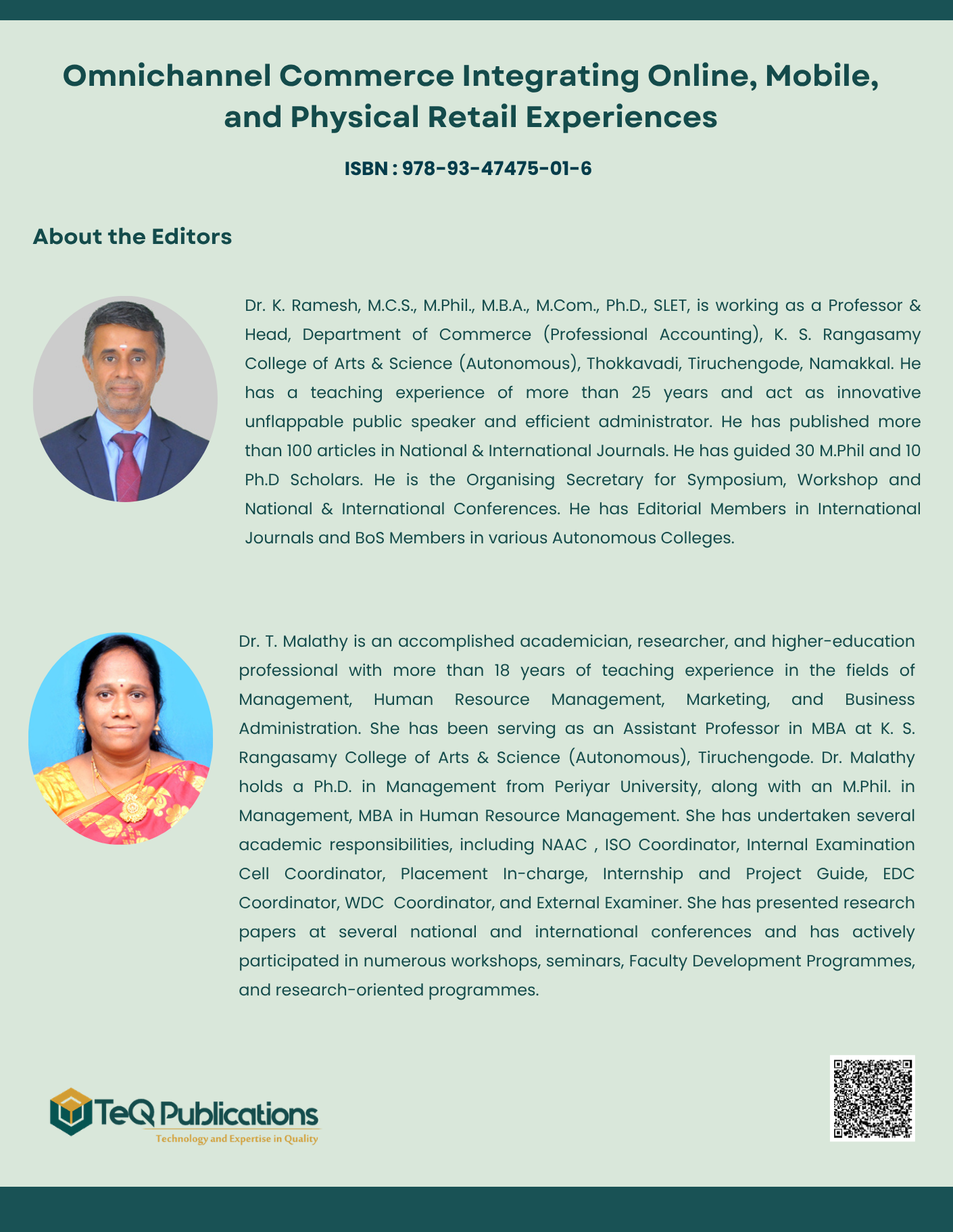
Dr. K. Ramesh, M.C.S., M.Phil., M.B.A., M.Com., Ph.D., SLET,
Head & Assistant Professor
K. S. Rangasamy College of Arts & Science(Autonomous)

Dr. T. Malathy, M.B.A., M.Phil., Ph.D.,
Assistant Professor
K. S. Rangasamy College of Arts & Science (Autonomous)
Back Cover