Author Book
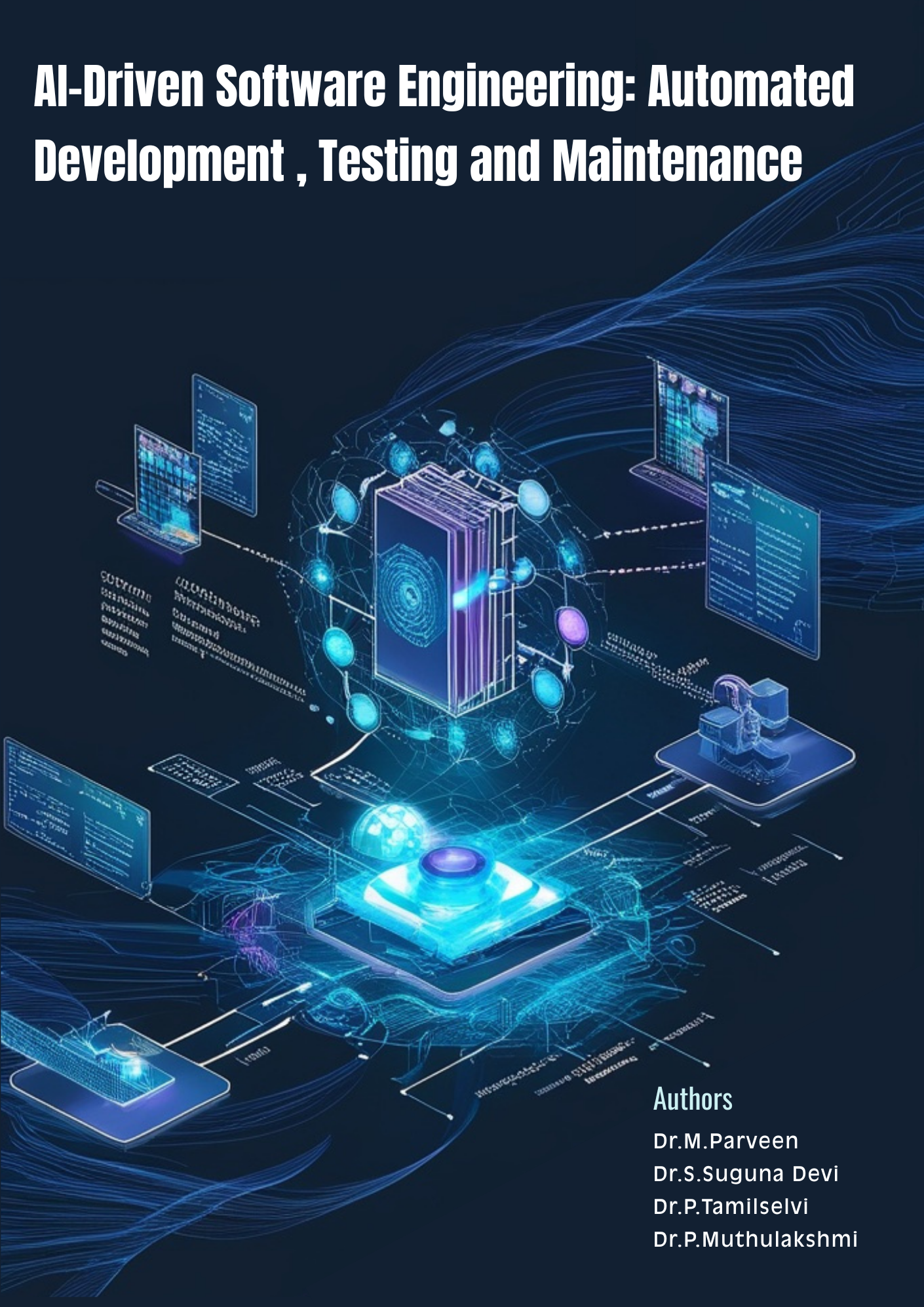
AI-Driven Software Engineering Automated Development, Testing and Maintenance
Published: August 2026
ISBN: 978-93-47475-03-0
DOI: https://doi.org/10.5281/zenodo.22092248
Pages: 285
About the Book
AI-Driven Software Engineering presents a comprehensive academic and practical exploration of how Artificial Intelligence is transforming modern software engineering across the entire Software Development Life Cycle (SDLC). As software systems become increasingly complex, distributed, data-intensive, and rapidly evolving, AI technologies such as Machine Learning (ML), Deep Learning (DL), Natural Language Processing (NLP), Large Language Models (LLMs), Generative AI, Explainable AI (XAI), and Agentic AI are creating new possibilities for intelligent, adaptive, and increasingly autonomous software development.
The book begins by establishing the foundations of AI-driven software engineering, tracing the evolution from traditional software development methodologies toward AI-assisted, AI-native, and autonomous development environments. It explains how AI can support requirements engineering, software design, programming, testing, deployment, maintenance, and continuous software evolution.
A major focus is placed on AI-assisted Requirements Engineering and Intelligent Software Design, covering intelligent requirement elicitation, analysis, classification, prioritization, validation, traceability, architecture recommendation, design-pattern selection, UML generation, and automated software modeling. The book further explores Generative AI and Large Language Models for automated code generation, including natural-language-to-code transformation, code completion, API recommendation, code translation, documentation, code review, refactoring, testing, and intelligent programming assistance.
The book provides detailed coverage of Intelligent Software Testing, including automated test-case generation, defect prediction, fault localization, intelligent quality assurance, continuous testing, AI-assisted code review, and self-healing testing. It also examines Machine Learning for software maintenance, refactoring, and technical debt management, demonstrating how AI can support software evolution, modernization, predictive maintenance, and long-term software quality.
Beyond software development, the book addresses AI-Driven DevOps, Continuous Integration, Continuous Delivery, and Intelligent Release Engineering. It explores intelligent build and deployment automation, monitoring, observability, anomaly detection, incident management, AIOps, MLOps, cloud-native development, Kubernetes, GitOps, and self-healing software operations.
Security, transparency, and responsible adoption form another important dimension. AI-Powered Software Security Engineering covers vulnerability detection, secure coding, threat intelligence, security analytics, DevSecOps, continuous security assessment, and proactive risk management. The book also examines Explainable AI, Trustworthy AI, Responsible AI, privacy, fairness, bias mitigation, intellectual property, accountability, governance, and regulatory compliance, emphasizing the importance of human oversight and responsible technological adoption.
Looking toward the future, the book explores Agentic AI, Autonomous Software Engineering, AI-Native Software Engineering, Multi-Agent Systems, Self-Healing Software, Digital Twins, and Quantum AI. These emerging paradigms point toward development environments in which intelligent agents can increasingly assist with requirements analysis, architecture, coding, testing, debugging, security, deployment, monitoring, and maintenance. At the same time, the book emphasizes that human expertise, creativity, critical judgment, validation, and accountability remain essential.
The book also establishes a connection between academic research and industrial practice through its coverage of empirical studies, benchmark datasets, software repositories, experimental evaluation, statistical analysis, reproducibility, industrial applications, performance assessment, and evidence-based AI adoption. This research-oriented perspective helps readers understand not only the capabilities of AI-driven software engineering but also its practical challenges, limitations, and opportunities for further investigation.
Designed for postgraduate students, research scholars, faculty members, software engineers, AI practitioners, researchers, technology professionals, and industry leaders, this book serves as a comprehensive reference for understanding the rapidly evolving intersection of Artificial Intelligence and software engineering.
At its core, AI-Driven Software Engineering advocates a human-centered approach in which AI augments human intelligence rather than replaces human responsibility. By combining intelligent automation with software engineering principles, security, explainability, ethical governance, and human expertise, the book provides a foundation for understanding and developing the next generation of reliable, secure, adaptive, and responsible software systems.
The book begins by establishing the foundations of AI-driven software engineering, tracing the evolution from traditional software development methodologies toward AI-assisted, AI-native, and autonomous development environments. It explains how AI can support requirements engineering, software design, programming, testing, deployment, maintenance, and continuous software evolution.
A major focus is placed on AI-assisted Requirements Engineering and Intelligent Software Design, covering intelligent requirement elicitation, analysis, classification, prioritization, validation, traceability, architecture recommendation, design-pattern selection, UML generation, and automated software modeling. The book further explores Generative AI and Large Language Models for automated code generation, including natural-language-to-code transformation, code completion, API recommendation, code translation, documentation, code review, refactoring, testing, and intelligent programming assistance.
The book provides detailed coverage of Intelligent Software Testing, including automated test-case generation, defect prediction, fault localization, intelligent quality assurance, continuous testing, AI-assisted code review, and self-healing testing. It also examines Machine Learning for software maintenance, refactoring, and technical debt management, demonstrating how AI can support software evolution, modernization, predictive maintenance, and long-term software quality.
Beyond software development, the book addresses AI-Driven DevOps, Continuous Integration, Continuous Delivery, and Intelligent Release Engineering. It explores intelligent build and deployment automation, monitoring, observability, anomaly detection, incident management, AIOps, MLOps, cloud-native development, Kubernetes, GitOps, and self-healing software operations.
Security, transparency, and responsible adoption form another important dimension. AI-Powered Software Security Engineering covers vulnerability detection, secure coding, threat intelligence, security analytics, DevSecOps, continuous security assessment, and proactive risk management. The book also examines Explainable AI, Trustworthy AI, Responsible AI, privacy, fairness, bias mitigation, intellectual property, accountability, governance, and regulatory compliance, emphasizing the importance of human oversight and responsible technological adoption.
Looking toward the future, the book explores Agentic AI, Autonomous Software Engineering, AI-Native Software Engineering, Multi-Agent Systems, Self-Healing Software, Digital Twins, and Quantum AI. These emerging paradigms point toward development environments in which intelligent agents can increasingly assist with requirements analysis, architecture, coding, testing, debugging, security, deployment, monitoring, and maintenance. At the same time, the book emphasizes that human expertise, creativity, critical judgment, validation, and accountability remain essential.
The book also establishes a connection between academic research and industrial practice through its coverage of empirical studies, benchmark datasets, software repositories, experimental evaluation, statistical analysis, reproducibility, industrial applications, performance assessment, and evidence-based AI adoption. This research-oriented perspective helps readers understand not only the capabilities of AI-driven software engineering but also its practical challenges, limitations, and opportunities for further investigation.
Designed for postgraduate students, research scholars, faculty members, software engineers, AI practitioners, researchers, technology professionals, and industry leaders, this book serves as a comprehensive reference for understanding the rapidly evolving intersection of Artificial Intelligence and software engineering.
At its core, AI-Driven Software Engineering advocates a human-centered approach in which AI augments human intelligence rather than replaces human responsibility. By combining intelligent automation with software engineering principles, security, explainability, ethical governance, and human expertise, the book provides a foundation for understanding and developing the next generation of reliable, secure, adaptive, and responsible software systems.
Book Editor(s) / Author(s)

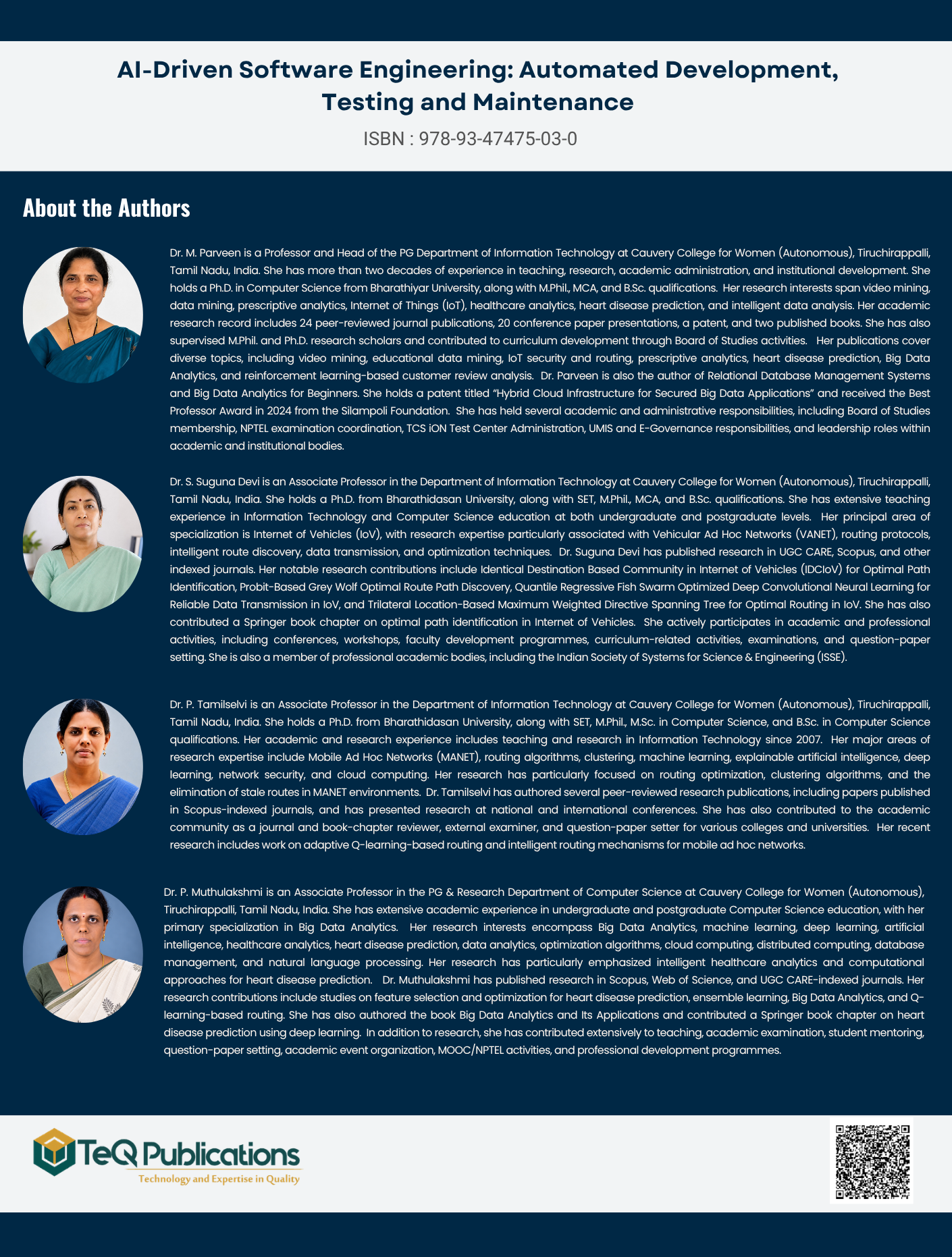
Dr. M. Parveen MCA., M.Phil., Ph.D.,
Professor & Head
Cauvery College for Women (Autonomous)

Dr. P. Muthulakshmi MCA., M.Phil., Ph.D., SET., NET.,
Associate Professor
Cauvery College for Women (Autonomous)

Dr. S. Suguna Devi MCA., M.Phil., Ph.D., SET.,
Associate Professor
Cauvery College for Women (Autonomous)

Dr. Tamilselvi M.Sc., M.Phil., Ph.D., SET.,
Associate Professor
Cauvery College for Women (Autonomous)
Back Cover