Chapter Book
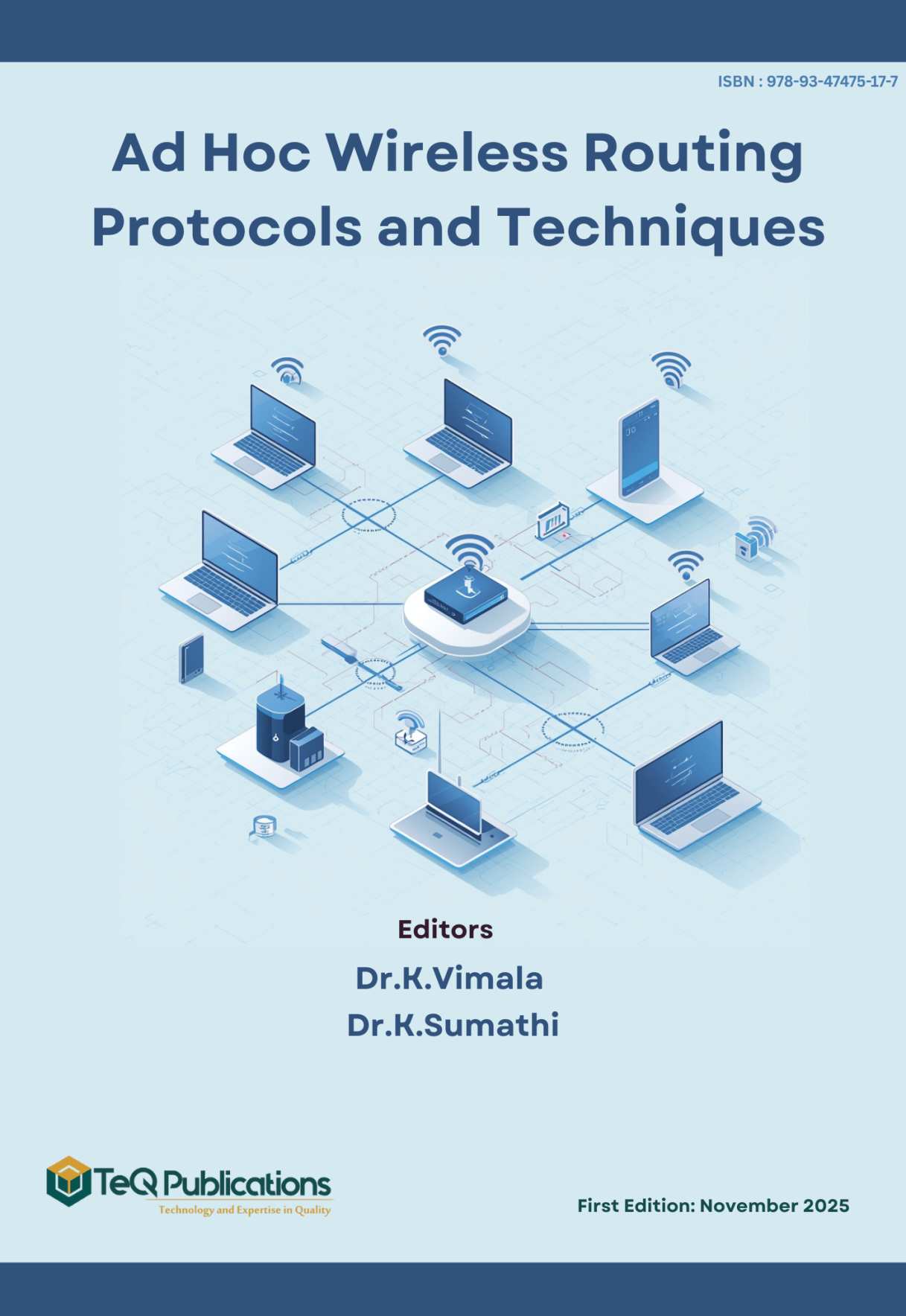
Ad Hoc Wireless Routing Protocols and Techniques
Published: November 2025
ISBN: 978-93-47475-17-7
Pages: 184
About the Book
The book “Ad Hoc Wireless Routing Protocols and Techniques” has been conceived as a comprehensive guide to understanding the evolving world of decentralized, infrastructure-less wireless communication systems. Over the past few decades, the concept of ad hoc networking has moved from experimental military applications to becoming an integral component of modern intelligent communication frameworks such as the Internet of Things (IoT), vehicular networks, unmanned aerial systems, and emerging 6G ecosystems. This transformation has been driven by rapid advancements in mobility, edge intelligence, and autonomous networking — all of which demand adaptable, energy-efficient, and secure routing solutions.
The motivation behind this book stems from the need to consolidate theoretical foundations, routing mechanisms, and emerging research directions within a single structured volume. While a significant body of literature exists on networking and communication systems, few resources provide an integrated view of both the classical and modern perspectives of ad hoc routing, spanning from the earliest distance-vector protocols to AI-assisted and quantum-secure designs. This book aims to bridge that gap by providing readers—be they researchers, engineers, or graduate students—with a deep yet practical understanding of routing paradigms that define today’s and tomorrow’s wireless connectivity.
The initial chapters (Chapters 1–2) introduce readers to the fundamentals of ad hoc wireless networks and the underlying routing principles that enable dynamic communication in mobile and infrastructure-less environments. These chapters lay the conceptual groundwork necessary to appreciate the complexity and elegance of routing in networks characterized by volatility, decentralization, and resource constraints. Subsequent chapters (Chapters 3–5) delve into the three major classes of routing protocols—proactive, reactive, and hybrid—highlighting their operational mechanisms, design trade-offs, and performance comparisons across diverse environments such as Mobile Ad Hoc Networks (MANETs), Vehicular Ad Hoc Networks (VANETs), and Flying Ad Hoc Networks (FANETs). These sections not only explain the theoretical models but also draw connections to real-world applications, including disaster response, military coordination, and smart city communication systems. Chapters 6 and 7 explore specialized routing domains—geographic and energy-efficient routing—where the focus shifts to optimization, sustainability, and context-awareness. While geographic routing leverages spatial intelligence for efficient data dissemination, energy-efficient techniques emphasize extending network lifetime through adaptive power management and resource balancing. Together, they illustrate how routing strategies evolve when constrained by environmental and hardware limitations.
The latter part of the book (Chapters 8–10) addresses advanced and forward-looking themes. Chapter 8 discusses Quality of Service (QoS)-aware routing, ensuring reliable and performance-driven communication, while Chapter 9 focuses on the pressing challenge of security—examining how trust, cryptography, and AI-driven defense mechanisms can safeguard ad hoc networks from evolving cyber threats. The final chapter, Chapter 10, envisions the future of ad hoc routing, exploring transformative technologies such as AI, blockchain, edge computing, and quantum networking that are redefining the very architecture of wireless communication in the 6G and beyond era.
This book is intended to serve as a reference and inspiration for researchers, academicians, and industry practitioners working in wireless communication, distributed systems, and intelligent networking. It seeks not only to document the state of the art but also to spark new ideas and research directions toward creating networks that are autonomous, adaptive, secure, and sustainable.
I extend my sincere gratitude to the pioneers of ad hoc networking research, whose groundbreaking contributions laid the foundation for this domain, and to the global research community continuously pushing the boundaries of wireless innovation. I am also thankful to my students, collaborators, and peers who provided critical feedback and insights during the development of this work.
It is my hope that “Ad Hoc Wireless Routing Protocols and Techniques” will serve as both a learning companion and a research catalyst for those seeking to understand, design, and advance the next generation of wireless ad hoc communication systems.
The motivation behind this book stems from the need to consolidate theoretical foundations, routing mechanisms, and emerging research directions within a single structured volume. While a significant body of literature exists on networking and communication systems, few resources provide an integrated view of both the classical and modern perspectives of ad hoc routing, spanning from the earliest distance-vector protocols to AI-assisted and quantum-secure designs. This book aims to bridge that gap by providing readers—be they researchers, engineers, or graduate students—with a deep yet practical understanding of routing paradigms that define today’s and tomorrow’s wireless connectivity.
The initial chapters (Chapters 1–2) introduce readers to the fundamentals of ad hoc wireless networks and the underlying routing principles that enable dynamic communication in mobile and infrastructure-less environments. These chapters lay the conceptual groundwork necessary to appreciate the complexity and elegance of routing in networks characterized by volatility, decentralization, and resource constraints. Subsequent chapters (Chapters 3–5) delve into the three major classes of routing protocols—proactive, reactive, and hybrid—highlighting their operational mechanisms, design trade-offs, and performance comparisons across diverse environments such as Mobile Ad Hoc Networks (MANETs), Vehicular Ad Hoc Networks (VANETs), and Flying Ad Hoc Networks (FANETs). These sections not only explain the theoretical models but also draw connections to real-world applications, including disaster response, military coordination, and smart city communication systems. Chapters 6 and 7 explore specialized routing domains—geographic and energy-efficient routing—where the focus shifts to optimization, sustainability, and context-awareness. While geographic routing leverages spatial intelligence for efficient data dissemination, energy-efficient techniques emphasize extending network lifetime through adaptive power management and resource balancing. Together, they illustrate how routing strategies evolve when constrained by environmental and hardware limitations.
The latter part of the book (Chapters 8–10) addresses advanced and forward-looking themes. Chapter 8 discusses Quality of Service (QoS)-aware routing, ensuring reliable and performance-driven communication, while Chapter 9 focuses on the pressing challenge of security—examining how trust, cryptography, and AI-driven defense mechanisms can safeguard ad hoc networks from evolving cyber threats. The final chapter, Chapter 10, envisions the future of ad hoc routing, exploring transformative technologies such as AI, blockchain, edge computing, and quantum networking that are redefining the very architecture of wireless communication in the 6G and beyond era.
This book is intended to serve as a reference and inspiration for researchers, academicians, and industry practitioners working in wireless communication, distributed systems, and intelligent networking. It seeks not only to document the state of the art but also to spark new ideas and research directions toward creating networks that are autonomous, adaptive, secure, and sustainable.
I extend my sincere gratitude to the pioneers of ad hoc networking research, whose groundbreaking contributions laid the foundation for this domain, and to the global research community continuously pushing the boundaries of wireless innovation. I am also thankful to my students, collaborators, and peers who provided critical feedback and insights during the development of this work.
It is my hope that “Ad Hoc Wireless Routing Protocols and Techniques” will serve as both a learning companion and a research catalyst for those seeking to understand, design, and advance the next generation of wireless ad hoc communication systems.
Book Editor(s) / Author(s)

Dr. K.Sumathi, M.Sc., M.C.A., M.Phil., B.Ed.,Ph.D
Assistant Professor
K.S. Rangasamy College Of Arts and Science (Autonomous)

Dr. K.Vimala M.Sc.,M.Phil.,Ph.D.,
Assistant Professor
SRM Arts and Science College
Back Cover