Author Book
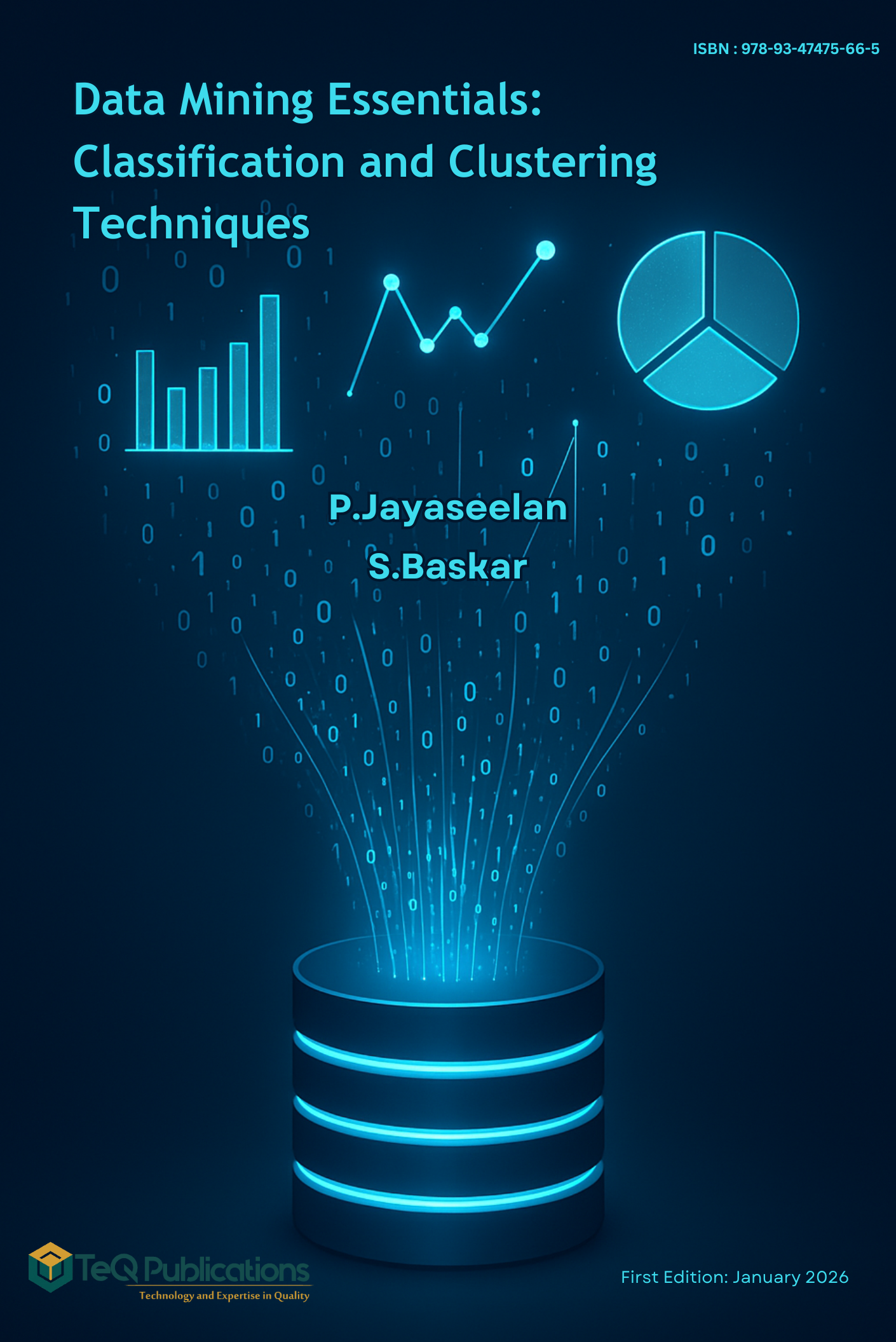
Data Mining Essentials: Classification and Clustering Techniques
Published: January 2026
ISBN: 978-93-47475-66-5
DOI: https://doi.org/10.5281/zenodo.18375930
Pages: 215
About the Book
The unprecedented growth of data in the modern digital world has transformed the way organizations, researchers, and governments make decisions. Every interaction—whether through online transactions, social media, mobile devices, sensors, healthcare systems, or scientific experiments—generates massive volumes of data. While data itself is abundant, actionable knowledge is not. The true value lies in the ability to systematically analyze data, discover hidden patterns, and extract meaningful insights that support intelligent decision making. This need has made data mining a central discipline in computer science, data science, and artificial intelligence. Data Mining Essentials: Classification and Clustering Techniques is written to address this need by providing a clear, structured, and application-oriented introduction to the fundamental methods that enable knowledge discovery from data.
This book focuses on two core pillars of data mining—classification and clustering—which together form the backbone of predictive and descriptive analytics. Classification enables supervised learning from labeled data to predict outcomes and support automated decision systems, while clustering uncovers intrinsic structures in unlabeled data, facilitating exploration, segmentation, and pattern discovery. By emphasizing these complementary paradigms, the book equips readers with a balanced understanding of how data mining techniques operate across a wide range of real-world scenarios. The book begins by establishing strong conceptual foundations. Chapter 1 introduces data mining within the broader context of the Knowledge Discovery in Databases (KDD) process, highlighting its interdisciplinary roots in databases, statistics, and machine learning. It clarifies essential terminology, outlines major data mining tasks, and discusses the practical challenges posed by large-scale, heterogeneous, and imperfect data. This introductory chapter sets the stage for a deeper exploration of techniques and methodologies that follow. Recognizing that high-quality data is a prerequisite for effective analysis, Chapter 2 is devoted entirely to data preprocessing and data quality. Real-world datasets are rarely clean or complete, and poor preprocessing can significantly degrade model performance. This chapter provides a systematic treatment of data cleaning, transformation, normalization, feature selection, and dimensionality reduction, emphasizing how thoughtful preprocessing enhances accuracy, interpretability, and generalization. By grounding advanced techniques in practical considerations, the chapter reinforces the idea that successful data mining begins long before an algorithm is applied. Chapters 3 through 7 focus on classification techniques, progressing from fundamental concepts to advanced models. The discussion begins with the essentials of supervised learning, model construction, and evaluation metrics, enabling readers to understand how predictive models are trained, tested, and validated. Decision tree classifiers are examined in depth for their interpretability and rule-based reasoning, while Bayesian and probabilistic classifiers demonstrate how uncertainty and prior knowledge can be incorporated into learning. Instance-based and linear classifiers highlight the role of similarity measures and linear decision boundaries, offering intuitive yet powerful approaches to classification. The treatment culminates with ensemble and advanced methods, including Random Forests, boosting techniques, and Support Vector Machines, which address complex, high-dimensional, and noisy datasets. Throughout these chapters, theoretical explanations are consistently linked with practical examples to reinforce learning. Chapters 8 through 10 shift the focus to clustering, the primary unsupervised learning paradigm in data mining. Beginning with fundamental concepts and objectives, the book carefully distinguishes clustering from classification and explains how similarity, cohesion, and separation guide the formation of meaningful groups. Partition-based methods such as k-means are explored in detail, including their optimization criteria, variants, and limitations. Hierarchical and density-based approaches are then introduced to handle complex data distributions, arbitrary cluster shapes, and noise. By comparing these methods in terms of scalability, robustness, and applicability, the book enables readers to select appropriate clustering techniques for exploratory analysis and real-world applications. Model evaluation and validation are treated as essential components of the data mining lifecycle in Chapter 11. Rather than viewing evaluation as a final step, the chapter emphasizes it as an integral process that informs model selection, tuning, and improvement. Both classification and clustering validation techniques are discussed, along with strategies to handle imbalanced data and prevent overfitting. This chapter empowers readers to critically assess model performance and reliability, fostering responsible and informed analytical practice. The final chapter bridges theory and practice by introducing widely used tools, frameworks, and real-world applications. By demonstrating how algorithms are implemented using popular platforms and Python-based workflows, the book helps readers translate conceptual knowledge into executable solutions. Real-world case studies illustrate the tangible impact of data mining in domains such as healthcare, business analytics, and fraud detection. Ethical considerations, privacy concerns, and emerging trends—including explainable AI, automated machine learning, and federated learning—are also discussed to provide a forward-looking and responsible perspective.
This book is intended for undergraduate and postgraduate students in computer science, information technology, data science, and related disciplines. It also serves as a practical reference for researchers, educators, and industry professionals seeking a concise yet comprehensive guide to classification and clustering techniques. The material is presented with minimal mathematical complexity, prioritizing conceptual clarity, intuition, and practical relevance. It is our hope that Data Mining Essentials: Classification and Clustering Techniques will not only support academic learning but also inspire readers to explore advanced research and innovative applications in data mining. By combining foundational theory, practical insights, and real-world relevance, this book aims to equip readers with the knowledge and confidence needed to harness the power of data in an increasingly data-driven world.
This book focuses on two core pillars of data mining—classification and clustering—which together form the backbone of predictive and descriptive analytics. Classification enables supervised learning from labeled data to predict outcomes and support automated decision systems, while clustering uncovers intrinsic structures in unlabeled data, facilitating exploration, segmentation, and pattern discovery. By emphasizing these complementary paradigms, the book equips readers with a balanced understanding of how data mining techniques operate across a wide range of real-world scenarios. The book begins by establishing strong conceptual foundations. Chapter 1 introduces data mining within the broader context of the Knowledge Discovery in Databases (KDD) process, highlighting its interdisciplinary roots in databases, statistics, and machine learning. It clarifies essential terminology, outlines major data mining tasks, and discusses the practical challenges posed by large-scale, heterogeneous, and imperfect data. This introductory chapter sets the stage for a deeper exploration of techniques and methodologies that follow. Recognizing that high-quality data is a prerequisite for effective analysis, Chapter 2 is devoted entirely to data preprocessing and data quality. Real-world datasets are rarely clean or complete, and poor preprocessing can significantly degrade model performance. This chapter provides a systematic treatment of data cleaning, transformation, normalization, feature selection, and dimensionality reduction, emphasizing how thoughtful preprocessing enhances accuracy, interpretability, and generalization. By grounding advanced techniques in practical considerations, the chapter reinforces the idea that successful data mining begins long before an algorithm is applied. Chapters 3 through 7 focus on classification techniques, progressing from fundamental concepts to advanced models. The discussion begins with the essentials of supervised learning, model construction, and evaluation metrics, enabling readers to understand how predictive models are trained, tested, and validated. Decision tree classifiers are examined in depth for their interpretability and rule-based reasoning, while Bayesian and probabilistic classifiers demonstrate how uncertainty and prior knowledge can be incorporated into learning. Instance-based and linear classifiers highlight the role of similarity measures and linear decision boundaries, offering intuitive yet powerful approaches to classification. The treatment culminates with ensemble and advanced methods, including Random Forests, boosting techniques, and Support Vector Machines, which address complex, high-dimensional, and noisy datasets. Throughout these chapters, theoretical explanations are consistently linked with practical examples to reinforce learning. Chapters 8 through 10 shift the focus to clustering, the primary unsupervised learning paradigm in data mining. Beginning with fundamental concepts and objectives, the book carefully distinguishes clustering from classification and explains how similarity, cohesion, and separation guide the formation of meaningful groups. Partition-based methods such as k-means are explored in detail, including their optimization criteria, variants, and limitations. Hierarchical and density-based approaches are then introduced to handle complex data distributions, arbitrary cluster shapes, and noise. By comparing these methods in terms of scalability, robustness, and applicability, the book enables readers to select appropriate clustering techniques for exploratory analysis and real-world applications. Model evaluation and validation are treated as essential components of the data mining lifecycle in Chapter 11. Rather than viewing evaluation as a final step, the chapter emphasizes it as an integral process that informs model selection, tuning, and improvement. Both classification and clustering validation techniques are discussed, along with strategies to handle imbalanced data and prevent overfitting. This chapter empowers readers to critically assess model performance and reliability, fostering responsible and informed analytical practice. The final chapter bridges theory and practice by introducing widely used tools, frameworks, and real-world applications. By demonstrating how algorithms are implemented using popular platforms and Python-based workflows, the book helps readers translate conceptual knowledge into executable solutions. Real-world case studies illustrate the tangible impact of data mining in domains such as healthcare, business analytics, and fraud detection. Ethical considerations, privacy concerns, and emerging trends—including explainable AI, automated machine learning, and federated learning—are also discussed to provide a forward-looking and responsible perspective.
This book is intended for undergraduate and postgraduate students in computer science, information technology, data science, and related disciplines. It also serves as a practical reference for researchers, educators, and industry professionals seeking a concise yet comprehensive guide to classification and clustering techniques. The material is presented with minimal mathematical complexity, prioritizing conceptual clarity, intuition, and practical relevance. It is our hope that Data Mining Essentials: Classification and Clustering Techniques will not only support academic learning but also inspire readers to explore advanced research and innovative applications in data mining. By combining foundational theory, practical insights, and real-world relevance, this book aims to equip readers with the knowledge and confidence needed to harness the power of data in an increasingly data-driven world.
Book Editor(s) / Author(s)

Mr. P.Jayaseelan, M.C.A., NET.,
Head and Assistant Professor
Hindustan College of Arts and Science

Mr. S.Baskar M.Sc.,M.Phil.,SET.,
Assistant Professor
Hindustan College of Arts and Science
Back Cover