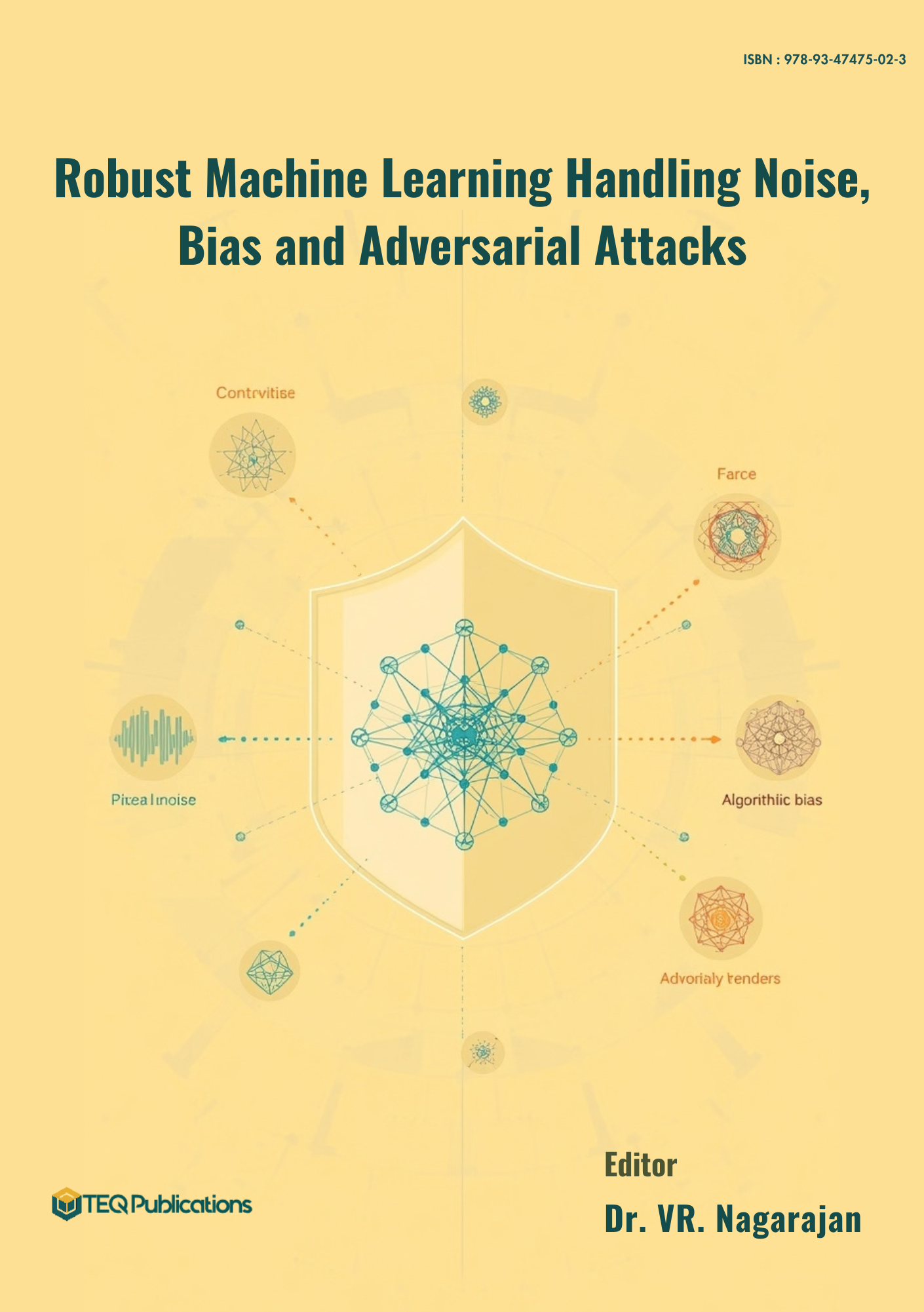
Robust Machine Learning Handling Noise, Bias and Adversarial Attacks
About the Book
The book begins by establishing the foundations of robust machine learning, covering robustness, generalization, uncertainty, data quality, and major sources of model vulnerability. It then examines statistical learning under noise and the challenges associated with feature noise, label noise, adversarial perturbations, and imperfect data. Comprehensive discussions of data quality and preprocessing address missing values, noisy and corrupted data, outliers, data cleaning, normalization, transformation, and data integration, emphasizing the importance of high-quality and representative datasets.
A significant portion of the book focuses on bias, fairness, and responsible machine learning. It explores data, algorithmic, human, measurement, and deployment biases, together with fairness criteria, detection methods, mitigation strategies, adversarial debiasing, and responsible AI considerations. The book subsequently introduces robust optimization and adversarial machine learning, covering uncertainty sets, min-max optimization, distributionally robust optimization, adversarial training, threat models, evasion attacks, poisoning attacks, and backdoor attacks. Various defense mechanisms, including defensive distillation, input transformation, detection techniques, certified robustness, and randomized smoothing, are also discussed.
The book further examines explainable and interpretable robust machine learning, highlighting the role of Explainable Artificial Intelligence (XAI), feature attribution, visualization, LIME, SHAP, counterfactual explanations, and interpretable models in developing trustworthy AI systems. It also discusses robust deep learning architectures and regularization methods, covering CNNs, RNNs, transformers, residual connections, gating mechanisms, dropout, L1/L2 regularization, label smoothing, Mixup, CutMix, stochastic depth, robust loss functions, and adversarial training.
Modern decentralized AI environments are addressed through a dedicated discussion of federated and distributed robust learning. Topics include data and model poisoning, Byzantine failures, privacy leakage, secure aggregation, differential privacy, secure multi-party computation, homomorphic encryption, scalability, communication efficiency, heterogeneous environments, edge computing, and IoT systems. The book also emphasizes the importance of evaluation and benchmarking, covering robustness metrics, adversarial evaluation, stress testing, distributional shifts, calibration, uncertainty estimation, benchmark datasets, reproducibility, standardization, and multi-metric assessment.
Finally, the book connects these theoretical and methodological perspectives with real-world applications in healthcare, finance, cybersecurity, autonomous systems, and other practical environments. It highlights the need to balance robustness, accuracy, fairness, explainability, security, computational efficiency, and deployment requirements when developing reliable AI solutions.
Table of Contents
Authors
- K. Vimala - Assistant Professor, Department of Computer Science, Alpha Arts and Science College, Chennai, Tamilnadu, India.
Abstract
Robust Machine Learning (RML) has become a fundamental area of research and practice, addressing the limitations of conventional machine learning systems when exposed to noise, uncertainty, adversarial manipulation, and dynamic real-world environments. This chapter provides a comprehensive foundation for understanding robustness in machine learning by examining its core concepts, underlying challenges, and practical significance. It begins with an overview of machine learning fundamentals and formally defines robustness, distinguishing it from generalization. The discussion then explores key sources of vulnerability, including noisy data, label inconsistencies, distribution shifts, and model complexity issues. Further, the chapter investigates adversarial threats, bias and fairness considerations, and the trade-offs between performance, robustness, and efficiency. It also presents widely used evaluation metrics, benchmark frameworks, and advanced techniques for enhancing robustness, such as data-centric methods, adversarial training, and robust optimization. In addition, the chapter highlights critical challenges in scalability, deployment, and standardization, while outlining emerging research directions. Finally, it emphasizes the broad scope and applications of robust machine learning across domains such as healthcare, autonomous systems, cybersecurity, and finance. Overall, this chapter serves as a foundational resource for students and researchers, offering both theoretical insights and practical perspectives for building reliable, secure, and trustworthy AI systems.
Keywords
Authors
- Dr. V. Hema - Assistant Professor, Department of Computer Science, Agurchand Manmull Jain College, Meenambakkam, Chennai,Tamilnadu, India.
Abstract
This chapter presents a comprehensive exploration of statistical learning under noise, addressing both theoretical foundations and practical implications in modern machine learning systems. It begins by defining noise and its various forms, including label noise, feature noise, and adversarial perturbations, and examines their impact on model performance and generalization. The chapter further discusses key principles of statistical learning theory, such as risk minimization and the bias–variance trade-off, in the context of noisy data. Advanced topics including noise modeling, robust loss functions, optimization techniques, and data cleaning methods are analyzed to provide practical strategies for mitigating noise effects. In addition, the chapter highlights probabilistic and Bayesian approaches for uncertainty modeling, along with real-world applications across domains such as healthcare, finance, and IoT. Emerging research directions, including weak supervision, self-supervised learning, and adversarial robustness, are also explored to provide insights into future challenges. Overall, the chapter emphasizes the importance of integrating data-centric and model-centric approaches to build robust, reliable, and scalable machine learning systems capable of operating effectively under imperfect data conditions.
Keywords
Authors
- Ranjini Ashok - Industry Specialist / Data Engineer Singapore
Abstract
Data quality and preprocessing are critical components in the development of robust and reliable machine learning (ML) systems. Real-world datasets often contain imperfections such as missing values, noise, outliers, inconsistencies, and integration issues, which can significantly impact model performance and generalization. This chapter provides a comprehensive overview of data quality challenges and the techniques used to address them. It explores methods for handling missing data, detecting and filtering noise, identifying and managing outliers, and transforming and normalizing data. Additionally, it discusses data integration, consistency management, and the design of scalable preprocessing pipelines. Emphasis is placed on automation, reproducibility, and real-time data processing using modern tools and frameworks. The chapter highlights the importance of data-centric approaches, demonstrating that improving data quality often yields greater benefits than modifying model architectures. By integrating statistical techniques, machine learning methods, and domain expertise, practitioners can build high-quality datasets that enhance model accuracy, fairness, and interpretability. Overall, this chapter underscores the role of preprocessing as a foundational step in the ML lifecycle, enabling the development of scalable, trustworthy, and high-performing machine learning systems for real-world applications.
Keywords
Authors
- S. Kishok Kumar - Department of Computer Science, Karpagam Academy of Higher Education (KAHE), Coimbatore, Tamilnadu, India.
Abstract
Bias in machine learning has emerged as a critical concern as data-driven systems increasingly influence decision-making across domains such as healthcare, finance, hiring, and criminal justice. This chapter provides a comprehensive examination of bias in machine learning, focusing on its sources, detection methodologies, and mitigation strategies. It begins by distinguishing between statistical and societal bias, highlighting how historical and structural inequalities can be encoded into data and amplified by algorithms. The chapter systematically explores various sources of bias, including data bias, algorithmic bias, human bias, measurement bias, and deployment bias, emphasizing their interconnected nature. Further, the chapter introduces foundational fairness concepts, including individual and group fairness, and discusses key fairness criteria such as demographic parity, equal opportunity, and equalized odds. It presents a detailed overview of bias detection and evaluation techniques, including exploratory data analysis, fairness metrics, and visualization tools, alongside the use of benchmark datasets and standardized evaluation frameworks. The discussion extends to bias mitigation strategies across the machine learning lifecycle, encompassing pre-processing, in-processing, and post-processing approaches, as well as advanced techniques such as adversarial debiasing, causal inference, and fairness in deep learning systems. In addition, the chapter reviews practical tools and frameworks for implementing fairness, along with relevant industry standards and regulatory perspectives, including data protection laws and emerging AI governance frameworks. It also addresses the challenges of operationalizing fairness in real-world systems, particularly in dynamic and large-scale environments. The chapter concludes by emphasizing the importance of integrating ethical principles, interdisciplinary collaboration, and continuous monitoring to ensure responsible AI development. Overall, this chapter serves as a foundational resource for students, researchers, and practitioners seeking to understand and address bias in machine learning systems
Keywords
Authors
- Dr.R.Sathya - Associate Professor, Department of Computer Science, Alpha Arts and Science College, Chennai, Tamilnadu, India.
Abstract
This chapter presents a comprehensive exploration of robust optimization techniques for machine learning models, emphasizing their critical role in handling uncertainty, noise, and adversarial perturbations in real-world environments. It begins by establishing the foundational concepts of robustness and contrasting standard optimization approaches with robust formulations that explicitly account for worst-case scenarios. The chapter systematically examines key methodologies, including adversarial training, regularization strategies, distributionally robust optimization (DRO), and Bayesian approaches for uncertainty modeling. It further discusses mathematical foundations such as min-max optimization and uncertainty sets, along with practical considerations for scalable implementation using stochastic gradient methods and modern machine learning frameworks. Special attention is given to the challenges of balancing robustness, accuracy, and computational efficiency, as well as addressing data imperfections and distributional shifts. The chapter also highlights real-world applications across domains such as healthcare, finance, and autonomous systems, underscoring the necessity of robust models in high-stakes decision-making. Finally, it outlines emerging directions that integrate robustness with fairness, explainability, and trustworthy artificial intelligence, positioning robust optimization as a fundamental component of reliable and deployable machine learning systems.
Keywords
Authors
- J. Janani - Assistant Professor, Department of Computer science and Applications, Vivekananda College of Arts and Sciences for Women (Autonomous), Tiruchengode, Tamilnadu, India.
Abstract
Adversarial machine learning has emerged as a critical research domain addressing the security and robustness challenges of modern machine learning systems. This chapter provides a comprehensive exploration of adversarial threats, beginning with foundational concepts such as adversarial examples and the formulation of threat models that define attacker goals, knowledge, and capabilities. It systematically examines a range of attack strategies, including evasion attacks at inference time, as well as poisoning and backdoor attacks during training, highlighting their mechanisms and real-world implications. The chapter further investigates domain-specific adversarial techniques across computer vision, natural language processing, speech systems, and cybersecurity applications, emphasizing the adaptability of attack methodologies. In addition, it analyzes the root causes of adversarial vulnerabilities, including model sensitivity, high-dimensional feature spaces, and decision boundary complexities, and discusses key evaluation metrics such as robust accuracy and perturbation norms. By integrating theoretical insights with practical considerations, this chapter underscores the growing importance of securing machine learning systems in safety-critical environments. It concludes by outlining current challenges, including the evolving arms race between attackers and defenders, and identifies future research directions focused on robust, explainable, and secure AI systems.
Keywords
Authors
- C. Aruna - Assistant professor, Department of cyber security and cognitive systems, Karpagam academy of higher education, Coimbatore, Tamilnadu, India
Abstract
The growing deployment of machine learning systems in safety-critical and real-world environments has amplified concerns regarding their vulnerability to adversarial attacks. These attacks exploit inherent weaknesses in model behavior by introducing imperceptible perturbations that can significantly degrade performance. This chapter provides a comprehensive examination of defense mechanisms designed to enhance the robustness and security of machine learning models. It begins by introducing the fundamental concepts of adversarial defense and proceeds to explore key strategies, including adversarial training, defensive distillation, input transformation techniques, detection-based mechanisms, and certified robustness approaches. The chapter also discusses robust architecture design, regularization methods, and emerging trends in transformer and graph-based models. Emphasis is placed on both theoretical foundations and practical implementation challenges, such as the trade-offs between robustness, accuracy, and computational efficiency. Furthermore, the chapter highlights the limitations of existing defenses under adaptive attack scenarios and underscores the importance of rigorous evaluation frameworks. By synthesizing current research and industry practices, this chapter aims to provide students and researchers with a structured understanding of how to design, evaluate, and deploy resilient machine learning systems. The discussion concludes by outlining future directions, including scalable certification techniques, adaptive defense strategies, and interdisciplinary approaches to AI security.
Keywords
Authors
- Thanga Jency T - Assistant Professor, Department of Computer Science, Alpha Arts and Science College, Chennai, Tamilnadu, India.
Abstract
The increasing deployment of machine learning systems in high-stakes domains has intensified the need for models that are not only accurate but also transparent and reliable. This chapter explores the integration of explainability, interpretability, and robustness as fundamental pillars of trustworthy artificial intelligence. It begins by introducing core concepts of explainable AI (XAI) and model interpretability, highlighting their distinctions and complementary roles in enhancing human understanding of model behavior. The discussion then extends to robustness, emphasizing its importance in ensuring consistent performance under adversarial perturbations, noisy data, and distributional shifts. The chapter systematically examines interpretability techniques, including intrinsic and post-hoc methods, feature attribution approaches, and visualization strategies, alongside robustness-enhancing techniques such as adversarial training and distributionally robust optimization. It further investigates the interplay between interpretability and robustness, demonstrating how explainability can reveal model vulnerabilities and support the development of more resilient systems. Practical design strategies are presented, including interpretable architectures, regularization methods, and human-in-the-loop approaches, supported by evaluation frameworks that jointly assess transparency and robustness. Applications across critical domains such as healthcare, finance, autonomous systems, and cybersecurity are discussed to illustrate real-world relevance. The chapter also addresses ethical considerations, fairness, and regulatory requirements, underscoring the societal implications of deploying AI systems. Finally, it identifies open research challenges and future directions, emphasizing the need for interdisciplinary collaboration. Overall, this chapter provides a comprehensive foundation for understanding and developing machine learning systems that are explainable, robust, and aligned with the principles of trustworthy AI.
Keywords
Authors
- J. Annie Jennifer - Assistant Professor, Department of Computer Science and Applications, Arul Anandar College (Autonomous), Karumathur, Madurai,Tamilnadu,India.
Abstract
Robust deep learning has become a critical area of research and practice as machine learning systems are increasingly deployed in real-world environments characterized by noise, uncertainty, and adversarial threats. This chapter provides a comprehensive examination of robust deep learning architectures and regularization methods, with a focus on Convolutional Neural Networks (CNNs), Recurrent Neural Networks (RNNs), and transformer-based models. It explores the inherent vulnerabilities of these architectures to noisy inputs, corrupted data, and distributional shifts, and presents advanced techniques to enhance their resilience. Key topics include data augmentation, robust filtering, attention regularization, and architectural innovations such as residual connections and gating mechanisms. The chapter further discusses classical and modern regularization approaches, including L1/L2 penalties, dropout, label smoothing, Mixup, CutMix, and stochastic depth, highlighting their role in preventing overfitting and improving generalization. In addition, it addresses training strategies for noisy and corrupted datasets, including robust loss functions, curriculum learning, semi-supervised learning, and adversarial training. The chapter also emphasizes the importance of evaluating robustness through specialized metrics, benchmark datasets, and stress testing under distribution shifts. By integrating architectural design, training methodologies, and evaluation frameworks, this chapter provides a holistic perspective on building reliable, secure, and scalable deep learning systems. It is intended to support students, researchers, and industry practitioners in developing robust AI models capable of performing effectively in complex and dynamic real-world scenarios.
Keywords
Authors
- Dr.V. Rani - Head and Assistant Professor, Department of Information Technology, Athoor Cooperative Arts and Science College, Seevalsaragu, Dindigul, Tamilnadu, India.
Abstract
Federated and distributed learning have emerged as transformative paradigms for enabling collaborative machine learning across decentralized and privacy-sensitive environments. This chapter explores the foundational principles, architectures, and challenges associated with these approaches, with a particular focus on robustness in adversarial settings. It examines key threats, including data and model poisoning, Byzantine failures, and privacy leakage attacks, and analyzes their implications for system reliability and security. The chapter further presents a comprehensive overview of defense mechanisms, such as Byzantine-resilient aggregation techniques, anomaly detection, and cryptographic methods including differential privacy, secure multi-party computation, and homomorphic encryption. Additionally, it highlights critical system-level challenges related to scalability, communication efficiency, and heterogeneity, while discussing the integration of federated learning with edge computing and IoT ecosystems. Emphasis is placed on the trade-offs between privacy, robustness, and model performance, as well as the need for adaptive and trustworthy solutions. The chapter concludes by identifying open research challenges and future directions, underscoring the importance of secure, scalable, and resilient decentralized AI systems for real-world applications.
Keywords
Authors
- Albert Irudaya Raj J - Assistant Professor and Head, Department of Information Technology, Arul Anandar college (Autonomous), Karumathur, Madurai, Tamilnadu, India.
- S. Naganandhini - Research Scholar, Department of Computer Science, Karpagam Academy of Higher Education (KAHE), Coimbatore, Tamilnadu, India.
Abstract
Evaluation metrics and benchmarking play a pivotal role in the development of robust machine learning (ML) systems, particularly as these systems are increasingly deployed in dynamic, high-stakes, and adversarial environments. This chapter provides a comprehensive exploration of methodologies for assessing robustness beyond traditional accuracy-centric evaluation. It begins by examining the limitations of conventional performance metrics such as accuracy, precision, recall, and F1-score, especially under conditions involving noise, adversarial perturbations, and distributional shifts. The chapter then introduces a diverse set of robustness metrics, including adversarial robustness measures, stability-based metrics, distributional generalization indicators, and calibration techniques for uncertainty estimation. Further, the chapter highlights the importance of benchmark datasets and standardized evaluation protocols in ensuring reproducibility, comparability, and scientific rigor. It discusses widely used robustness benchmarks, stress testing methodologies, and adversarial evaluation techniques that expose model vulnerabilities under worst-case scenarios. Emphasis is also placed on reproducibility and standardization practices, addressing challenges related to experimental variability, reporting transparency, and the use of open-source tools. Finally, the chapter presents multi-metric comparative evaluation strategies and practical guidelines for selecting robust models by balancing trade-offs among accuracy, robustness, and computational efficiency. Overall, this chapter establishes a holistic framework for evaluating and benchmarking machine learning models, enabling the development of reliable, secure, and trustworthy AI systems for real-world applications
Keywords
Authors
- H.Bhargath Nisha - Assistant Professor, Department of Computer Science (IoT & AIML), Nehru Arts and Science College, Coimbatore, Tamilnadu, India.
Abstract
Robust Machine Learning (RML) has become a critical paradigm for deploying reliable and trustworthy artificial intelligence systems in real-world environments characterized by noise, uncertainty, and adversarial threats. This chapter presents a comprehensive exploration of the applications of robust machine learning across key domains, including healthcare, finance, cybersecurity, and autonomous systems. It examines how robust techniques address challenges such as noisy and incomplete data, distributional shifts, adversarial manipulation, and system-level vulnerabilities. Through domain-specific case studies—ranging from medical diagnosis and fraud detection to intrusion detection and autonomous navigation—the chapter highlights the practical significance of robustness in ensuring consistent model performance and operational safety. In addition to application-focused discussions, the chapter analyzes cross-domain challenges, including trade-offs between robustness, accuracy, and computational efficiency, as well as issues related to scalability, deployment, and generalization. It further emphasizes the integration of explainability and fairness into robust machine learning pipelines to ensure transparency, accountability, and ethical compliance. Emerging trends such as federated learning, certified robustness, and formal verification are also discussed, providing insights into future research directions and technological advancements. Overall, this chapter underscores the importance of robustness as a foundational requirement for building resilient, scalable, and trustworthy machine learning systems capable of operating effectively in complex, real-world settings.
Keywords
Book Editor(s) / Author(s)

Dr. VR. Nagarajan M.C.A., M.Phil., Ph.D.,
Associate Professor
School of Engineering and Technology, Dhanalakshmi Srinivasan University
Back Cover